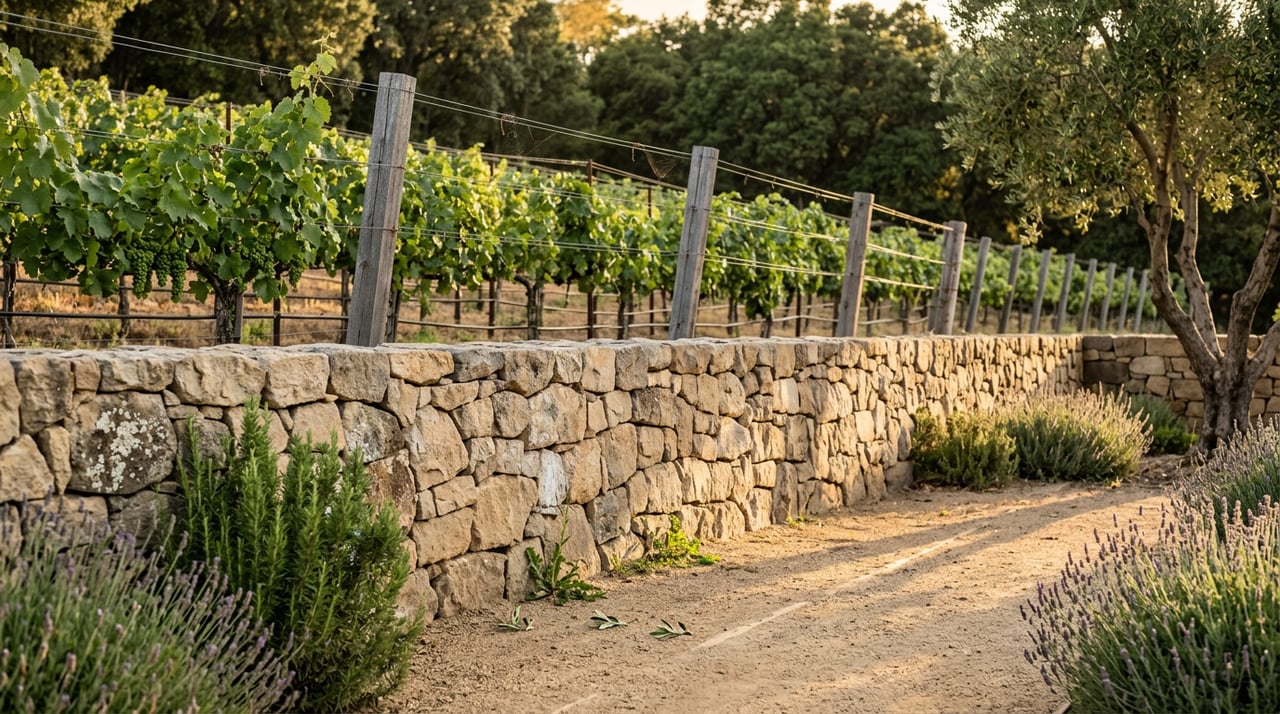
Drive past Moraga Canyon on any given Tuesday and you'll see what looks like a private road leading to a private house. Behind that gate sits a working vineyard, 6.9 acres of Cabernet Sauvignon, Cabernet Franc, Merlot, and Sauvignon Blanc planted on a hillside that climbs to 900 feet, and most people who live within a mile of it have never seen the vines. Even the winemaker knows it. "It's just a regular neighborhood," Paul Warson has said of the reaction he gets from people discovering Moraga Bel Air exists. The gate, as he puts it, is tall enough that you wouldn't know what's behind it until someone opens it for you.
That's the honest starting point for talking about a Bel Air weekend. As of February 2026, OpenTable lists exactly six restaurants inside the neighborhood's boundaries. Compare that to the walkable strips that define Brentwood's San Vicente corridor or West Hollywood's street grid, and the math doesn't work the way it does elsewhere in Los Angeles. Bel Air isn't short on things to do. It's short on storefronts to walk to. What fills the gap is a short list of specific, often gated, often appointment-only anchors, and knowing them is closer to knowing a neighborhood than any restaurant roundup could be.
The One Address That Keeps Reinventing Itself
Here's a detail that says more about Bel Air's commercial footprint than any survey could: one address, 662 North Sepulveda Boulevard, has carried three different restaurant identities within recent memory, because there is nowhere else nearby to put a fourth. The building operated for years as The Bel-Air Restaurant, itself a rename of the old Bel-Air Bar & Grill. It later became Umberto's Trattoria & Cantina, a Italian-and-Mexican concept that built a following with regulars who praised a server named Tony and a private dining room for small parties. As of 2026, the same space has relaunched again, now as Umberto Bar & Grill, with daily happy hour, live music, trivia nights, and a kitchen that closes at 10 p.m.
| Era | Concept | Cuisine |
|---|---|---|
| Earlier years | The Bel-Air Restaurant (formerly Bel-Air Bar & Grill) | American |
| Recent years | Umberto's Trattoria & Cantina | Italian-Mexican |
| 2026 | Umberto Bar & Grill | American bar and grill |
This isn't a story about a restaurant struggling to find its footing. It's a story about a neighborhood with so little commercially zoned land that new concepts have to inherit old addresses instead of opening new ones. If you've lived here through two or three of these name changes, you already understand the constraint. If you're newer, it's worth knowing that the churn on Sepulveda isn't instability. It's scarcity.
Where the Village Square Actually Sits
If Bel Air has anything resembling a town center, it's not on a street. It's inside the Hotel Bel-Air, where a dining program overhaul launched in 2024 has turned the lobby into something closer to a local gathering spot than a hotel amenity. Culinary director Joe Garcia, who trained under Thomas Keller at The French Laundry and earned Michelin stars at Manzke in 2022 and 2023, took over the property's kitchens and, alongside pastry chef Christophe Rull, a titled U.S. Chocolate Master who later appeared on Netflix's Bake Squad, launched two new concepts in 2024: The Living Room and The Patisserie.
The Patisserie sits in a courtyard just across the hotel's Swan Lake bridge, turning out croissants, tarts, and a sourdough made from a ten-year-old mother levain. The Living Room, the reimagined lobby lounge, is where the neighborhood's version of a coffee shop meeting happens over caviar service and a martini program instead. When The Hollywood Reporter covered the launch, afternoon tea was priced at $140 per person. By March 2026, Eater LA's roundup of the city's best afternoon tea listed the same service at $350 for two, closer to $175 a head. That's roughly a 25 percent jump per person in under two years, which tells you less about inflation and more about how quickly a hotel dining room can become the default answer to "where should we meet" when there's no coffee shop down the block to compete with it.
A Fire Road With Better Sightlines Than Most Driveways
For the outdoor half of a Bel Air weekend, the neighborhood's best-kept secret isn't a park. It's a fire road. Getty View Trail starts behind an iron gate at the end of Casiano Road, reached by taking the Moraga Drive exit off the northbound 405, turning onto Bellagio Road, and following it until it becomes Casiano. There's no formal parking lot, just street parking near the trailhead, which is part of why it stays quiet even as it delivers some of the best unobstructed views of the Getty Center from any public trail in the city.
A few specifics worth knowing before you go:
- The main route runs about 1.3 miles out to a private-property gate that marks the turnaround, for a round trip close to 2.6 miles.
- Elevation gain on the standard route is modest, around 220 feet, on a wide, well-graded fire road.
- The trail offers a clear sightline toward Brentwood's MountainGate Country Club as well as the Getty Center itself.
- It's multi-use and pet-friendly, so expect mountain bikers and dog walkers sharing the road.
- A side route along the ridgeline exists for hikers who want more elevation and rougher terrain, branching off the main fire road near the turnaround gate.
It's an easy hike by Santa Monica Mountains standards, which is exactly why it works as a regular habit rather than a special occasion. You can be back at your car in under an hour and still catch the entire skyline shift as the marine layer burns off.
The Vineyard Nobody Walks Past on Purpose
Circle back to Moraga Canyon, because the vineyard behind that gate deserves more than a passing mention. The 14-acre estate was originally the horse ranch of director Victor Fleming, who shot Gone With the Wind and The Wizard of Oz and hosted Vivien Leigh, Jean Harlow, Spencer Tracy, and Clark Gable there through the 1930s and 40s. Aerospace executive Tom V. Jones bought the property in 1959 and, two decades later in 1980, planted the first vines, Chardonnay and Sauvignon Blanc. Those vines fell to Pierce's disease within a few years, so Jones replanted in 1983 with red Bordeaux varieties instead. The first commercial vintage came in 1989. A barrel-aging cave followed in 2004 and a proper winery in 2005, making Moraga one of the first wineries bonded in the city of Los Angeles since Prohibition ended.
Rupert Murdoch bought the estate in 2013 with a commitment to keep it a working vineyard rather than developable land, a promise his son Lachlan has continued. Tastings today happen only by appointment, priced around $150 per person for groups of one to twelve, and occasional chef-paired dinners bring in outside talent for seated meals among the vines. None of it is visible from the road. That's the point. In a neighborhood built on privacy as a design principle rather than an inconvenience, the vineyard is Bel Air's clearest example of an amenity that exists specifically because almost nobody knows to look for it.
What This Actually Means for a Weekend Here
Put the pieces together and the pattern is obvious once you see it. Bel Air doesn't organize a weekend around a corridor you can wander. It organizes one around a handful of specific, often gated destinations that require a bit of intent: a reservation at a hotel dining room built by chefs with real pedigree, a trailhead you have to know to look for, a vineyard tasting you have to book in advance, and one recycled restaurant address on Sepulveda that keeps finding new life because there's nowhere else for it to go. None of that is a shortcoming. It's the tradeoff that comes with a neighborhood where privacy was the design brief from the start.
Neyshia Go and The Go Group work these same canyon roads and hillside addresses every week, representing estates across Bel Air for Sotheby's International Realty. If you're curious what else has changed in the neighborhood this year, or you're ready to talk about your own address here, schedule a confidential consultation and start the conversation.